Friday, July 30, 2010

What will Hodgson's Liverpool look like?

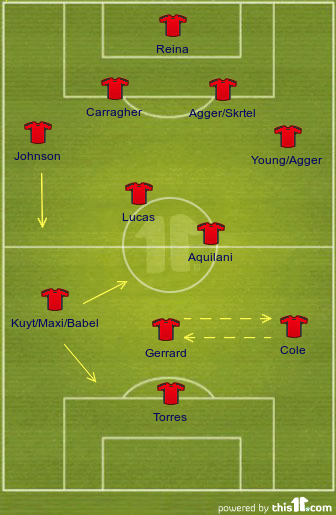
Under Rafa Benitez, Liverpool generally lined up in a 4-2-3-1 in 08/09 and 09/10, and produced some of the best and worst football of Benitez's tenure during that time span. The question is whether new manager Roy Hodgson (who often uses variations on 4-5-1) will stick with this formation, or try something different. Liverpool's current squad seems to work best in a 4-2-3-1, but that may be we are just used to seeing Liverpool in a 4-2-3-1. Here's a possible set up for Liverpool for next season in 4-2-3-1 (all the formations are assuming the Javier Mascherano leaves for Internazionale, Dirk Kuyt doesn't, Fernando Torres stays and that Luke Young arrives from Aston Villa):


In this set-up, Steven Gerrard and Joe Cole can interchange between the left flank and the hole behind Fernando Torres, which would probably be the best option, as it seems that both prefer to play in the hole. Kuyt would be the obvious first choice on the right wing, since he can attack, help Johnson against quality left wingers or fullbacks, or cut inside to add an extra man to the midfield, but there are other options if he leaves, though they don't provide the versatility and work rate that Kuyt does. Maxi Rodriguez and Ryan Babel could also leave, but both might wish to stay, given Hodgson's ability to get the best out of players who struggle under other managers. Also, Maxi's performance at the World Cup suggests that, while his best days might be behind him, he's not the completely spent force that he appeared to be last season with Atletico Madrid and Liverpool.

Another option for Hodgson would be the 4-4-2 he used with Fulham in the Europa League:
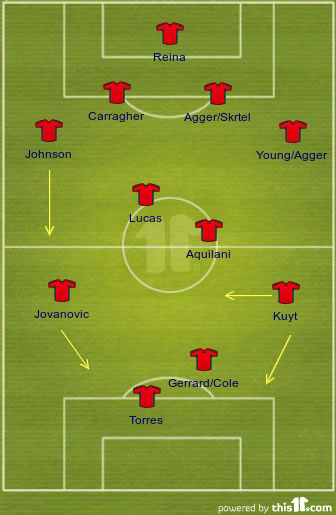

This set up could also be described as a 4-4-1-1 or even 4-2-2-2. For a comparison to Hodgson's Fulham set up, think Torres = Zamora, Gerrard/Cole = Gera, Kuyt = Dempsey/Davies and Jovanovic = Duff. Hodgson used inverted wingers with Fulham, who were able to cut inside easily, which produced a fairly narrow formation (hence the mention of 4-2-2-2). Kuyt had a great World Cup playing on the left for Holland. However, I don't know much about Jovanovic (other than that he's left-footed and can play up top or on the wing), so I don't know if he would work on the right flank. It would be useful to be able to play in this formation, but I don't know if would work as a default.

It will be interesting to see who leaves and if Hodgson makes any more signings. Retaining Kuyt is important. Because of Torres' injuries, I don't think any club (except maybe Man City) would risk the massive transfer fee he would command, so he will probably be with Liverpool next season. Squad depth will be key, I think, because Cole, Torres, Aquilani and Agger have had injury problems, and it would be unrealistic to depend on all of them for every game. Even Gerrard had his share of injuries last season. It will also be interesting to see if anyone from Liverpool's youth squad can get regular games. Those who played against FK Rabotnicki did well. Perhaps Liverpool could try an Arsenal-style youth team for the Carling Cup. There's lots of interesting possibilities for this team in the coming season.

Tuesday, July 20, 2010

World Cup Final

First, the better team won the World Cup final. There's no question that Spain outplayed the Dutch. One might even be tempted to say that the victory of the most technically proficient side in the world over one who resorted to anti-football almost immediately is a victory for football. However, let's be clear: Spain's victory was not a victory for attacking football.

Lazy analysts seem to think that Spain victory always = attacking football. This is simply not the case. Spain's quick, passing style, tiki-taka, is, as Sid Lowe has pointed out on Football Weekly, as much a defensive strategy as it is an attacking strategy. In the final, Spain dominated possession, and looked good doing so, but very rarely actually created goal scoring opportunities. David Villa wasted the one genuine chance that they created, after Jesus Navas' great run and cross (let it be said, though, that bringing on Navas to run at Giovanni Van Bronkhorst was a great substitution by Vicente del Bosque; had Navas been more consistent with his delivery, Spain might have created many more chances). Holland, on the other hand, had two great chances, both squandered by Arjen Robben.

As in most cup (especially World Cup) finals, both teams prioritized not conceding over scoring. The strategies by which they did this looked very different, but both are fundamentally a waiting game. Holland sat back, tried to break up play, tried to foul Spain out of their rhythm, and waited for a mistake by the other team or moment of individual brilliance from one of their creative players (and by that I mean their one creative player, Wesley Sneijder). Spain too played a waiting game. They passed. And passed. And passed. Spain played keep-ball for most of the game and, like Holland, waited for a mistake or a moment of individual brilliance. The goal came from a combination of both.

This is not to say that Spain can't or don't play attacking football; they just did not in this particular match. A good comparison might be Barcelona's victory over Chelsea in the 2009 Champions League semi-final. Barcelona played more attractive, more technically proficient, football, but it wasn't necessarily any more attacking. And like this match, that one was settled by a great goal by Andres Iniesta. Make no mistake, Spain did not play anti-football the way Holland did, but they definitely played defensive football. It was more attractive, more technically sound, and, ultimately, better football than Holland played, but it was in no way more attacking.

Goals Are Overrated

Goals are overrated: a recurring joke on The Guardian's Football Weekly podcast. This blog: observations about soccer by an American who would like to call it football, but would rather avoid confusion. "Goals are overrated" might have further resonance with those who follow football here in the United States, especially those who try to watch live streaming matches on a certain sports network's website because the network itself chooses to show bass fishing rather than the Premier League, and the stream has no problems until the build up to a goal, when one can hear the commentator yell "goal" while the video gets stuck on the manager gesticulating wildly. The stream is, of course, back and working just fine just in time to see the goal scorer get booked for removing his shirt. Anyway, there should be actual posts soon.